GALLERY

Monday, 6 October 2014

‘BALANCING THE RIGHTS AND RESPONSIBILITIES'


Last Saturday, the, African university College of Communications (A.U.C.C) Chapter of Journalists for Human Rights(J.H.R) organised a clean-up exercise in Adabraka  and its environments under the theme 'BALANCING RIGHTS AND RESPONSIBILITIES'. 
 The club was supported by Zoomlion Ghana with personnel and logistics.
Zoomlion and some executives and members


The patron of the club, Mrs. Barbara Gyamfi, who was happy about this activity, commended the members and executives for embarking on such an exercise. The president, Mr. James Kojo Dzierkpor, in an interview with Metro TV, said it was only right that the club undertook such an exercise and it was their responsibility to make people aware of their rights. He also said it was very necessary that as a people, Ghanaians should learn to balance their right and responsibilities.


gathering the garbage
some members and executives


The club also spoke at the school's orientation session for the new students and informed students of the aims and objectives and benefits of the club.

communications officer, Ebenezer Campbell Anim and the team spaeking to the Freshers...
A large number of students showed interest in the club and subsequently joined.

The communications officer of the club, Ebenezer Campbell Anim ,the vice president, Christiana Ekenam, Roberta Abbeyquaye, the Deputy Organizer and Gloria Amoah, the financial secretary spoke to the new students. 


 The club's clean up exercise was  supported by Champion Restaurant and covered by Adom Fm, Capital TV and Metro TV.


Thursday, 4 September 2014

THE AWUTU AWUBIA (HARVEST OF GRAIN) FESTIVAL…


ABOUT THE PARAMOUNT CHIEF…
Nai Wyettey Agyemang Otabi III was born in Accra Newtown to Madam Efua Atta Ajumako and Mr. Joseph Kwame Wyettey, the first Gyaasehene of Dode Royal Family of Awutu. He started his elementary education at the Newtown Experimental School then joined his aunt, Madam Ashiekuma at Bontrasi where he completed middle school. He pursued further at the Canadian Technical Institute now the Accra Technical Training Center (ATTC) and graduated in electrical engineering/ mining engineering in Germany.
He was enstooled as the paramount chief of Awutu Traditional Area in 2002.
He met his wife Mrs. Mary Wyettey in 1975 and has three sons together.


The festival celebration…
The Awutu Awubia festival and the Ga H)m)w) are celebrated almost in the same manner, however, the Ga hoot at hunger whilst the Awutu thank their god for a bountiful harvest. In addition, the Awutu celebrate their ‘Awubia’ a month after the Ga have celebrated their H)m)w). The town is usually crowded so much that it causes heavy traffic.


It is believed that some of the Awutu’s have their ancestors coming from the Ga and therefore, some celebrate both festivals; the H)m)w) first and the Awubia a month later.
The Awubia festival commences on the last Thursday in August and ends on the first Thursday in September. The calculation is done by ‘Otsor’ the priest of a god or shrine they call ‘Odia Otu’. The priest sows a grain and harvest it when ready. After his harvest, all paths leading to the capital town (main town) is cleared. The paternal groups/ families leave for their paternal homes to celebrate yam festival after which the Awubia festival would start. All this activity happens in May- June. By this time, everyone else starts harvesting and brings some to their ancestral home. They also cook for the departed souls.
On the last Thursday in August, which is the first day of celebration, all families return home. Around 3-4 pm, the ‘Abundam’, a divisional chief goes to the outskirt of the town (southern territory) and rides through the town in a palanquin to ‘Oguafododobia Ano’, the place where chiefs swear an oath of allegiance. There, libation is poured and the festival officially commences. During this period, the various heads of families also perform their own rituals for their family stools. They lift them from where they have been kept for the whole year to a special place in the same room after which they pour libation.


The second, third and fourth days are meant for feasting. The various families cook ‘Kpokpoi’ and serve some to the ‘black stools’ (They are called black stools because of the purification method). There is also the pouring of libation after which everyone is permitted to drink. Each family has their own special time for feasting.

On the fifth day of celebration which is Monday, the chiefs go on a parade. Those who are financially sound and want to be carried in palanquins are carried; others who are not walk from the north to the south western part of the town to a place called ‘Mamprobi’, the cemetery for chief, to pour libation. After this, they go to the durbar ground where the paramount chief and other dignitaries address the people.

There is a special order for carrying the chiefs; it is believed that the paramount chief needs to protected hence, the ‘Adontehene’, who is the first divisional chief comes first, followed by some divisional chiefs, then the paramount chief who is followed by the ‘Kyidomhene’, the last divisional chief and other divisional chiefs.
On the Tuesday, new chief are sworn in and the traditional council also goes to the various chiefs for their token.
 Wednesday is a resting day for all and the settling of disputes between family members in the various families.
On the last day, Thursday, between 4-5pm, all family or ‘black stools’ that were raised to their special places are sent back to where they were raised from and that ends the celebration of the festival.


CREDIT; MKB ABBEYQUAYE (my dad)

The Gyase Kwei Banafo V, 

Of Tsotso Botwe Royal Anona Clan of Awutu Traditional Area


Sunday, 24 August 2014

'Our main objective is to promote Ghana or creative works through handiworks'

The African Consciousness Youth Uprising Foundation    
The African  ConsciousnessYouth Uprising Foundation Last Saturday organized a program at the Afua Sutherland for crafty and talented people to exhibit their African and hand made products. Their main objective is to promote Ghana’s culture through handiworks….
The founder and brain behind the foundation, Derrick Nana Sampong Darkwa, in an interview said
‘This program is a youth talent explosion and the theme promoting Africa’s culture through talent and creativity. Our main objective is to promote Ghana or creative works through handiworks and we are here to promote ACYUF
ACYUF has been in existence since 1997 and we are still operating but we find it difficult sometimes, we have ‘Kente’ weavers, tailors, beads makers, basket weavers, artist and a lot more.
When we talk of ACYUF is all about creativity and handiwork’


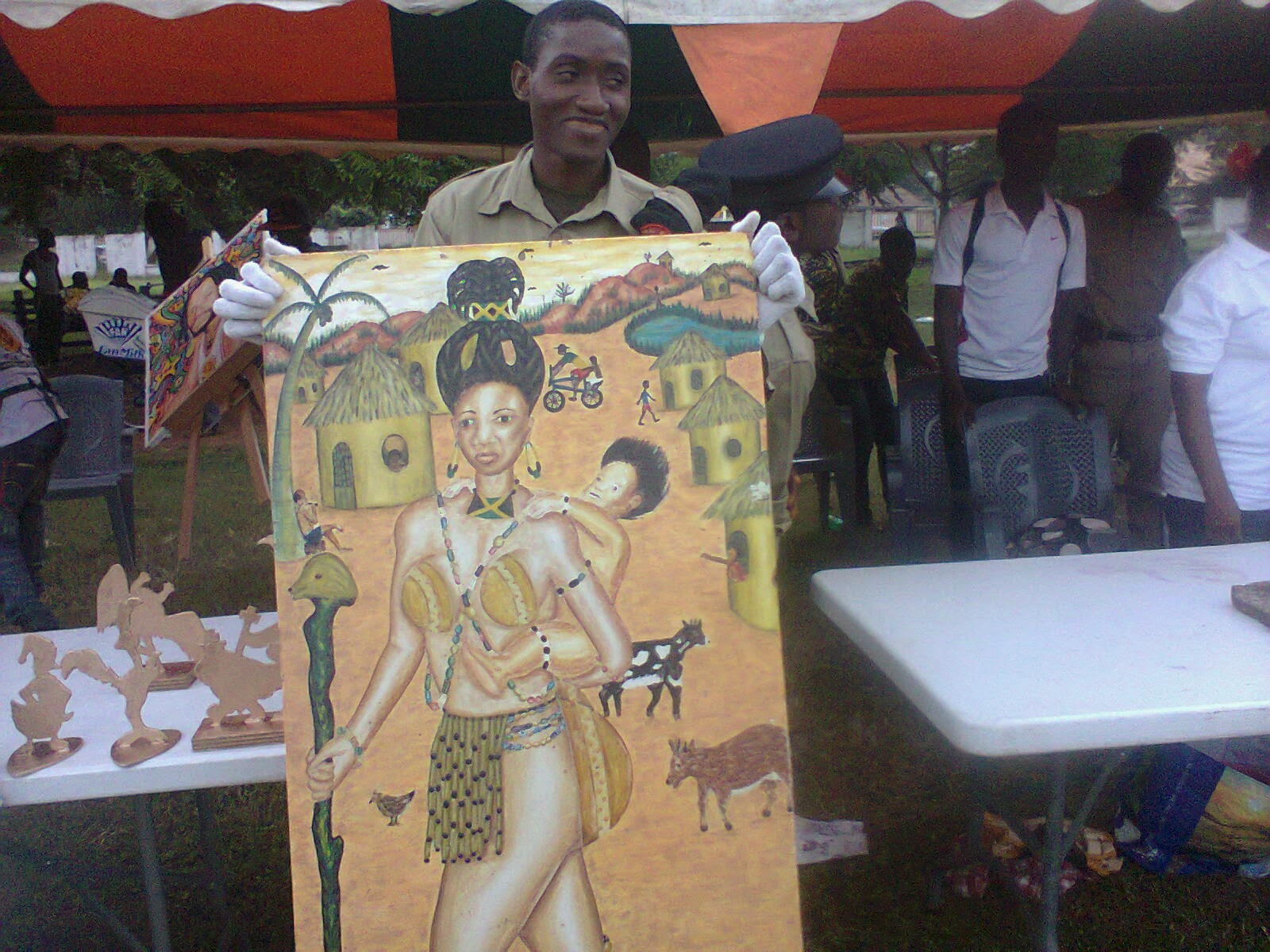
A PAINTING OF DERRICK, THE FOUNDER OF ACYUF BY ONE MEMBER
Nelson Yawman also came with his crew to exhibit their bamboo bicycles.  According to him, the frames are made up of bamboo and are joined by treated local fiber.


‘It is needs hard work and if you are not serious you can’t make it. We have about 30 bikes and we export them, we sell them for about ghc thousand five hundred (1500) depending on the type. All we do is team work. We have two branches, one in Accra and one in Kumasi, African items’. He said.


George is a basket weaver and was also at the park to exhibit his items.
‘I have sold about six as at now. The price ranges from ghc2 to 10 depending on the type and size of it' he told me. After a chat with George, he gave me a basket for free.

There were other items like beads, bags, and curvings...


the exhibition was interspersed with series of drama

Thursday, 31 July 2014

CHOLERA OUTBREAK IN GHANA…


The Korle-bu Polyclinic started recording cases of cholera as early as April this year; however, the epidemic has seen a significant increase especially after the celebration of the Sallah.
Patients received treatment at the Polyclinic’s O.P.D due to inadequate facilities. The only structure available for these patients was a wooden “one”. 


According to the head of the polyclinic, DR. DAVID NII NARH NOPRTEY, that structure was built some years back when the country had a similar case. He further stated that, it took the intervention of some people to still keep that structure; otherwise, there would have been no where to keep the patients.
The structure was used to accommodate patients with severe cases only. Other patients were kept and treated either at the O.P.D or a part of the clinic (on the corridor) designated to cholera patients.
In an interview, with the Public Nurse in-charge, ADELAIDE YEBOAH, more patients were being transferred from the community hospitals to the polyclinic each day. There was also the problem of inadequate nurses to tackle the issue at hand.  She added that most of the patients lived or came from areas like Chorkor, Agbogbloshie, Agege and Jamestown.
 According to her, close to 20 cases of cholera had been recorded just that morning and was sure more patients were going to be brought in.
In an interview with two patients, they had told us that they did not know exactly what was wrong with them until they came to the clinic, where they were told they had cholera. They added that they do not know exactly what caused it. Also, they said that their first point of contact was the pharmacy shop because they didn’t suspect it was cholera. They only considered going to the hospital some time later when the situation was not getting any better.  These patients have been admitted at the facility since Saturday and have taken series of drips.


Speaking to the sister of an 18 year old patient, she told us that her sister had returned from school ill, she took her to a hospital in the vicinity (Dansoman), only to be told she was ill of cholera. According to her, her sister was admitted for some days but was later transferred to the Korle-bu polyclinic when they could no longer handle it. At the Dansoman hospital, she was given 16 drips and was already taking her 15th at the polyclinic. She has also been at the clinic since Saturday.
In her final words, the public nurse in charge, ADELAIDE YEBOAH, advised that THE FIRST POINT OF CONTACT FOR EVERYONE WHEN THEY FEEL THEY ARE SICK SHOULD BE THE HOSPITAL OR CLINIC AND NOT THE PHARMACEUTICAL SHOPS. SHE ALSO ADDED THAT EVERYONE IN THESE TIMES SHOULD AT LEAST HAVE O.R.S WITH THEM JUST IN CASE OF AN EMERGENCY. FINALLY, SHE SAID THAT WE SHOULD MAKE SURE THAT WE MAINTAIN PROPER HYGIENE AND AS MUCH AS POSSIBLE TRY COOKING FOR THEMSELVES.


Tuesday, 29 July 2014

THE HEALTH CONDITIONS OF THE SCRAP DEALERS...


Old fadama

The town seems to shelter people of all countries and ages. It is a town where we can find one of the biggest scrap sites in Ghana and scrap business seems to be the most lucrative, easiest, common and most open to all as children are seen there too.  Scraps are waste products usually metals that are recyclable. One who deals in scraps either gathers them or buys them. More often, those who gather them are more at risk as some of these wastes will have to go through burning processes to obtain the actual material or scrap. The environmental condition under which this is done makes us ask the question: ARE THEY HEALTHY?
The sites of two young brothers reveal the danger and health problems associated with this kind of job. With emotions and tears running down his face, the younger who is eight years old, discloses that for a day, he earns ghc2.oo, which he gives to his mother when he gets back home. Although it has only been a short while since he started this job, his eye colour has changed from its original state to reddish brown. He explains this is not the only problem with the eye; there are times   it itched. According to him, he has told his mother time without number but with no remedy as a result of the same problem which has driven him to such a job or place;money.
.
Ramdan is an 18 years old immigrant from Togo. ‘This is where I work’ he said. During the day, Ramdan gathers some scraps and sells it out to buyers before the day gets older. ‘At most i earn ghc 15.00’ he added. According to Ramdan, he is into this business so he can save enough money to buy some items he needs as a mechanic in Togo, a job he has been into since he was six years. He lives in Ghana with an auntie. Concerning his health, Ramdan explains he has no health issues now although from the he used to have some headaches when he began the job. To him, those headaches were normal and have nothing to do with his job.
Earnings from the site seems to be based on age, hard work and how much /many scraps an individual gathers in a day. Joshua is a 15years old boy from Nigeria. As compared to Ramdan, he earns ghc 3.00, spends ghc1.00 a day and saves ghc 2.00 with a microfinance collector (Susu collector). Joshua lives with eleven (11) other boys in a room. According to him, he needs money so he could go to Nigeria and see his mother all by himself since his father for long has refused him the opportunity. Joshua is at this site without any family member’s knowledge. At the genesis of the job, he explains he had some headaches which he experiences no more. Just like Ramdan, he thinks this has nothing to do with the job. To cure the headache, he will also simply go to the pharmaceutical shop and get a pain reliever. He is okay after taking the drug given him.
Apart from these two brothers whose presence and story have revealed the dangers associated with the scrap job, all others who have been interviewed have only complained of headaches. They seem not to realize the dangers associated with this business. This seems to be as a result of the fact that they are used to the environmental conditions. With smoke all over the place one cannot help but to conclude that these headaches are as a result of the surroundings and the conditions under which they work.